
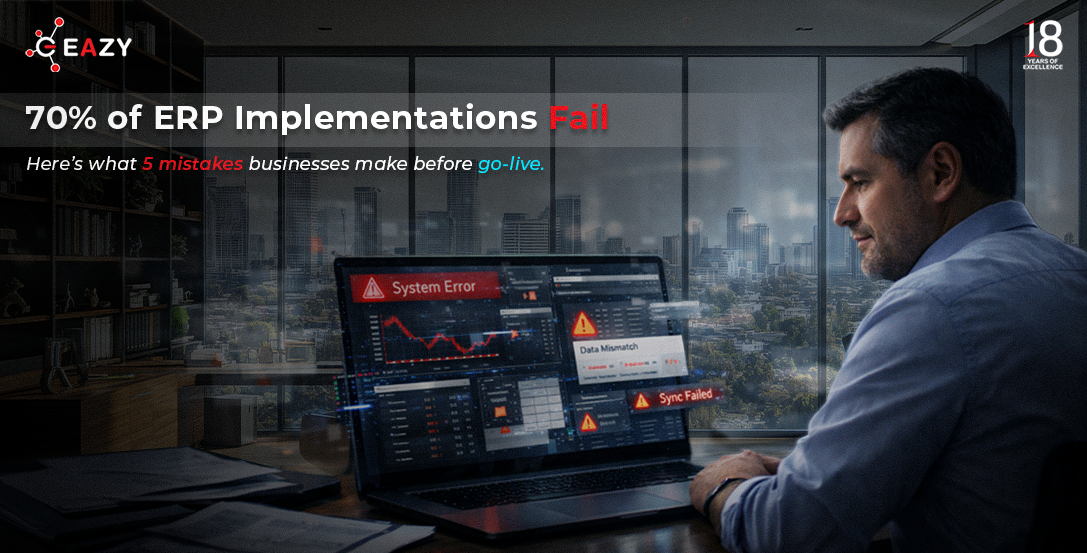
When ERP Fails, It’s Usually Not the Technology
A manufacturing company implements ERP after months of planning. The expectation is clear: better visibility, tighter control, and faster decisions across the business. But a few months after go-live, something unexpected happens. Teams still maintain excel sheets, approvals move through WhatsApp, and reports still require manual reconciliation. The ERP system is installed, yet the business continues to run the obsolete way.
This situation is more common than most organisations realise. According to the Panorama Consulting ERP Report, nearly 55–75% of ERP implementations fail to deliver their expected outcomes. After working with 650+ manufacturing and distribution businesses for 18+ years, we’ve seen a consistent pattern. ERP projects rarely fail because of the software itself. They fail because organisations underestimate how deeply ERP changes processes, decision-making, and operational accountability.
ERP is not just technology, it is a shift from people-driven operations to system-driven businesses, and that shift is exactly where many implementations struggle. Let’s look at the 5 most common reasons.
Reason 1. Leadership Treats ERP Like an IT Project
When ERP implementation is treated only as an IT responsibility, the business impact is often underestimated. An ERP system connects core functions like finance, inventory, procurement, production, and sales, which means leadership involvement is critical from the beginning. Without clear direction from decision-makers, teams struggle with priorities, adoption slows down, and the system never reaches its full potential. Successful ERP implementations happen when leadership treats ERP not as a software deployment, but as a business transformation initiative that reshapes how the organisation operates.
Reason 2. Companies Try to Automate Broken Processes
One of the biggest ERP implementation mistakes businesses make is trying to automate inefficient processes. When unclear workflows, multiple approvals, and duplicate data entry move directly into an ERP system, the problems don’t disappear, they simply become digital. Instead of improving efficiency, the system ends up replicating the same operational confusion at a larger scale. Successful ERP adoption begins by first simplifying and clearly defining processes, and only then using ERP to automate and streamline them.
Reason 3. Cultural Resistance Inside the Organization
ERP systems introduce a level of operational transparency that many organizations are not accustomed to. Real-time visibility into inventory, production delays, and financial impact makes business performance clearer than ever. However, this sudden transparency can create resistance within teams who are used to informal processes or manual workarounds. Without strong transformation management and leadership support, employees may revert to Excel sheets or parallel reporting systems. While ERP technology can be implemented quickly, true adoption requires time, training, and cultural alignment across the organization.
Reason 4. Messy Data Migrates Into the New System
ERP systems are only as reliable as the data they run on. When businesses migrate legacy data without proper cleaning or validation, issues like duplicate records, incomplete product details, and inconsistent customer information quickly affect system accuracy. As a result, reports become unreliable and decision-makers lose confidence in the ERP system. Proper data preparation and standardization during implementation may seem time-consuming, but it is essential for ensuring accurate reporting, operational visibility, and long-term ERP success.
Reason 5. Inadequate Training and Adoption
Even the most advanced ERP system cannot deliver value if employees are not properly trained to use it. ERP implementation significantly changes daily workflows, from data entry to reporting and process execution. Without structured, role-based training, users often struggle with system accuracy and decision-making insights. This leads to low adoption and employees reverting to old methods. Successful ERP implementation depends not only on the technology itself, but also on preparing teams with the right training, support, and confidence to use the system effectively.
The Real Lesson Businesses Often Miss
ERP implementations rarely fail because of software. They fail because companies underestimate the transition from: managing operations through people to running the business through systems. Technology is only the final step, the real work happens in:
- process clarity
- leadership alignment
- organisational adoption
When these foundations are strong, ERP becomes far more than an accounting system. It becomes the operational control center of the business.
A Final Thought from 18+ Years of ERP Experience
Over the years, we’ve noticed a clear pattern. Companies that treat ERP as a strategic operating system succeed. Companies that treat it as just another software implementation struggle. The difference is not the technology, it’s the mindset. If you’re evaluating ERP for your manufacturing or distribution business, the real question isn’t: “Which ERP should we buy?” It’s: “Are we ready to run our business through systems?”
If you’d like to explore what that shift looks like in practice, you can request a walkthrough of how modern ERP systems provide real-time operational visibility.
Book a quick demo with us.
We provide a holistic unified ecosystem from ERP, DMS, SFA, to retail platforms, so that your business doesn’t feel broken.
References:
Panorama Consulting Group Research Reports “The 2025 ERP Report: Implementation Trends and Success Factors” “ERP Implementation Failure Case Studies and Analysis” Available at: www.panorama-consulting.com
Gartner Research Publications “ERP Implementation Success Factors and Failure Analysis” “Cloud ERP Market Analysis and Trends 2024-2025” Available at: www.gartner.com
Deloitte ERP Implementation Studies “ERP Implementation Best Practices and ROI Analysis” Available at: www2.deloitte.com
Academic Research Papers Chen, C., Law, C., Yang, S. (2009). “Managing ERP Implementation Failure: A Project Management Perspective.” IEEE Transactions on Engineering Management, 56(1). Dezdar, S. and Ainin, S. (2011). “The Influence of Organizational Factors on Successful ERP Implementation.” Management Decision, 49(6): 911-926. Markus, M.L. and Tanis, C. (2000). “The Enterprise System Experience: From Adoption to Success.” In Framing the Domains of IT Management, Cincinnati, OH: Pinnaflex Educational Resources.
https://www.linkedin.com/pulse/why-70-erp-implementations-fail-hidden-organizational-andre-zv8ee/