If You Won’t Buy the Low-Priced Machine for Your Factory, Why Do It with ERP?
“55% of ERP projects end up costing more than originally budgeted, and over 60% take longer than expected.” reported in an ERP report by a USA based Consulting.
After 18 years of working closely with manufacturers and distributors, I’ve noticed something interesting. “When a factory needs a new machine for the shop floor, the discussion is serious. Teams compare reliability, downtime risk, service support, lifespan, spare availability, and ROI.” Nobody says, “Let’s buy the cheapest one” because everyone understands one truth: production cannot afford experimentation.
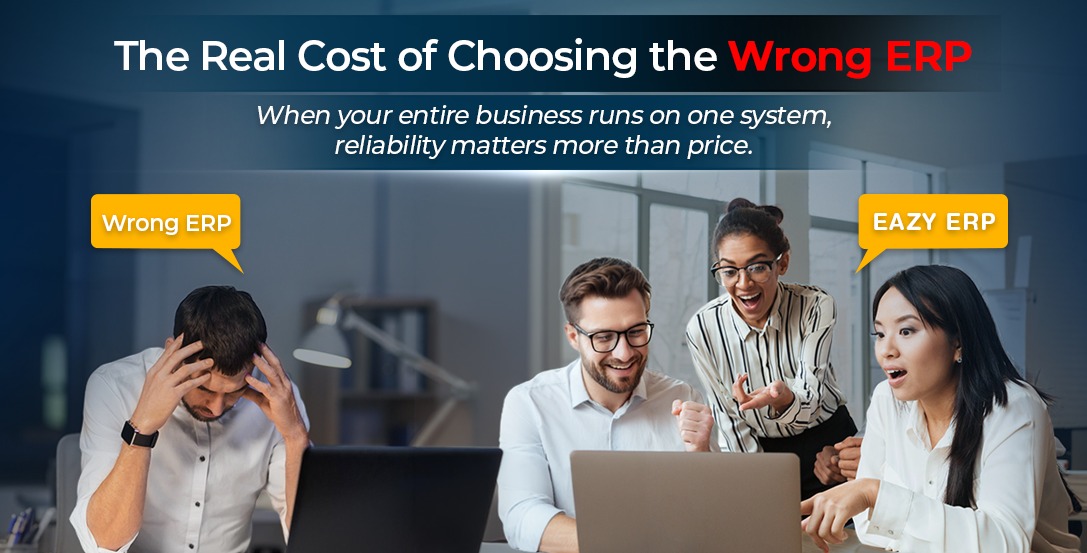
But when it comes to ERP, the system that runs finance, inventory, production, dispatch, procurement, and sales, suddenly the first filter becomes price. That is where costly mistakes begin.
ERP Is Not a Software Expense But Your Operational Backbone.
A machine affects one production line but ERP affects the entire organization. When ERP underperforms, the damage doesn’t look dramatic at first, it shows up quietly:
- Sales teams lose real-time visibility.
- Inventory mismatches increase.
- Finance spends days reconciling data.
- Reports don’t match ground reality.
- Decision-making slows down.
According to Gartner, more than 70% of ERP initiatives fail to fully meet their original business case goals. That failure rarely happens because ERP software is “bad.” It happens because businesses treat ERP as a purchase decision instead of a strategic investment.
The Illusion of “Low-cost ERP”
Let’s be blunt, there is no such thing as inexpensive ERP, there is only deferred cost. When you choose a low-cost ERP without industry depth, here’s what typically follows:
- Implementation timelines stretch.
- Customizations multiply.
- Internal teams lose confidence.
- Adoption drops.
- You depend heavily on the vendor for every minor change.
- Within 3–5 years, you outgrow the system.
And migration the second time is always more expensive, both financially and emotionally. In manufacturing and distribution, where margins are tight and working capital cycles matter, operational inefficiency quietly erodes profitability far more than ERP license cost ever will.
Cost vs. Value? The Question Most Businesses Avoid
The real question isn’t: “How much does this ERP cost?” but the real question is: How much inefficiency is this ERP removing? If your ERP can reduce inventory holding by even 5%, improve order processing speed by 10%, or shorten financial closing cycles by a few days, the ROI compounds year after year. But that only happens when the ERP understands your industry, things that generic systems rarely do.
Why Industry Experience Matters More Than Price
ERP is not just coding, but it is business process architecture. Manufacturing has its own complexity: BOMs, batch traceability, production planning, wastage control, multi-location stock visibility. Distribution has its own: dealer schemes, secondary sales tracking, route planning, credit management, demand forecasting. If your ERP partner has not lived these realities across multiple businesses, you become their experiment. Over the last 18 years, I’ve seen both scenarios:
→ Companies that chose on price often came back within a few years looking for stability.
→ Companies that chose based on reliability and industry understanding scaled smoother, adopted faster, and made data-driven decisions with confidence.
The difference was not software, It was depth.
Also, downtime of a machine is visible, everyone sees it but downtime of ERP is silent. It appears as manual Excel sheets re-emerging, whatsApp orders creeping back in, shadow systems forming, leadership making decisions on outdated reports, and slowly, the organization loses trust in its own data. That is far more expensive than any implementation fee.
A Founder’s Perspective:
If ERP is going to run your: Finance, Inventory, Production, Sales, Procurement, and Strategic Planning, does it make sense to experiment with the lowest bidder? Or should you choose a partner with proven experience, structured implementation capability, and long-term commitment? In my experience, businesses that treat ERP as infrastructure, not as a cost-saving opportunity, build stronger, more scalable organizations. The decision you take today will either simplify the next decade of growth, or complicate it.
Choose carefully.
If you are evaluating ERP options and want clarity beyond pricing discussions, I invite you to explore what a stable, industry-aligned ERP foundation looks like. Because correcting a wrong ERP decision is always more expensive than making the right one the first time. Take the first step Book a demo today.