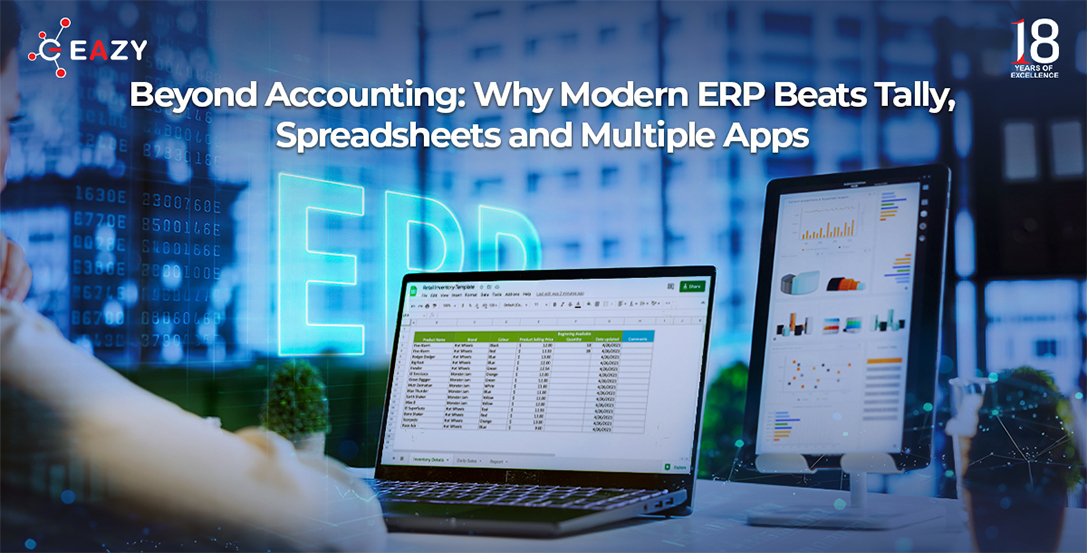
Beyond Accounting: Why It’s Time to Replace Tally, Spreadsheets & Multiple Apps with a Modern ERP
You think your books are under control. But are they really?
Every day, business owners lose hundreds of hours reconciling numbers across Tally, Excel, and scattered apps. Orders slip, inventory goes off-track, cash flows blur and most don’t even notice the money rotting on the table, until it’s too late.
In almost two decades of consulting and implementing business systems, we’ve seen firsthand how a modern ERP becomes the backbone of reliable, scalable operations. Let’s dive into why, in 2025, staying on outdated systems isn’t just inconvenient, but it’s costly. Here’s why it’s time to make a move.
The Problem with Old Habits: Why Tally + Spreadsheets + Apps Break Down
- Data fragmentation and silos: The problem that comes with using multiple excel, different apps, or systems with separate inventory is that you end up with scattered data across files and platforms. Now, this would lead to mismatch, duplication and confusion when each department or team has its own shared piece of truth.
- Manual workload and human errors: As businesses grow in size and volume, mistakes are bound to creep in and might stay silent for days, eventually harming your financials and inventory accuracy. These error-prone, time-consuming tasks include manual entries, copy-pasting, and reconciling ledgers.
- Slow, reactive decision-making: Standalone excels, or apps from different vendors do not have the capacity to give real-time data. Even the reports made from the amalgamation of all these go stale with time, so even the decisions become reactive rather than being proactive, and eventually kill agility.
- Scalability bottlenecks: As businesses grow with time, data multiplies, and processes diversify, systems that were perfect at a time start becoming obsolete and choke as teams expand. Now, subsequently adding new modules or branching out becomes a nightmare when you rely on such disjointed tools.
What a Modern ERP Does Differently And Better?
- Unified data across departments: All the departments, be it finance, inventory, sales, HR, procurement, come live in a single system via ERP. It’s like everyone is able to see the same data without discrepancies.
- Automation & elimination of redundancies: Routine tasks such as invoicing, payroll, reconciliation, and purchases become automated when businesses start using ERP. This leads to less manual work and eventually fewer errors.
- Real-time dashboards and analytics: The Majority of delays happen due to misplanning and misalignment in report governance. ERP gives you access to instant visibility of cash flow, stock levels, sales, margins, and KPIs through analytics and easily skimmable dashboards, helping stakeholders to make quick, data-driven decisions.
- Scalable & future-ready: As a business grows, the company starts diversifying its products, so it can cater to more consumer segments. This, in turn, adds to the responsibility of introducing new modules. This is where ERP scales seamlessly, without you resorting to patchwork solutions.
- Cost savings & ROI: Numerous studies revealed that firms implementing ERP meet or exceed ROI expectations, including lower inventory costs, reduced administrative overheads, and efficiency gains in just a few months of deployment.
- Better collaboration and fewer silos: Departments are finally able to talk to each other via real data, not solely through manual spreadsheets. This favors team alignment, and everyone works on the same page.
- Compliance, audit trails & security (if cloud/modern ERP): Instead of ad-hoc spreadsheets lying around, every document, folder, or number in the system is auditable, secure and backed up, which is vital to avoid any case of regulatory, investor or audit scenarios.
Why “One Tool for Everything” Matters Today?
In 2025 and the coming years, businesses are not going to be linear. Supply-chain disruptions, rapid scaling, remote/hybrid teams, and dynamic markets all demand flexibility, transparency, and speed. A new-age ERP not just replaces any accounting software or Excel, but it becomes the operational backbone of a business without being rigid.
So now, whether you’re tracking stock across multiple warehouses or plants, monitoring cash flow across departments, coordinating sales, orders, and production, or ensuring compliance and audit readiness, a stable ERP keeps everything connected without stressing you out.
With 18 years of experience behind us, we’ve seen how one mis-entry in a spreadsheet or a delayed reconciliation can cost more than what you save by avoiding software costs. Over time, inefficiency compounds. A robust ERP halts that leakage early.
When It’s Time to Make the Switch?
If you recognise any of these in your business:
- Multiple disconnected apps (accounting, inventory, payroll)
- Frequent data duplication, errors, or reconciliation issues
- Slow or manual month-end closings
- Reporting delays or a lack of real-time insights
- Difficulty scaling operations as business grows
- Lack of audit trails, compliance issues, and data security concerns
Then treating accounting as just “books” is limiting you. It’s time to move what you do daily, across finance, operations, inventory, and sales, into one unified, modern ERP.
With nearly two decades of experience, we don’t just implement software; we help build systems that grow with your business, reduce risk, and deliver long-term value. If you want to see real-world transformation, faster closings, fewer errors, better cash-flow visibility, and unified operations, we invite you to take a free demo with us.
Let’s stop patchwork solutions. Let’s build a foundation that scales.