Why Enterprise ERP Systems Fail Growing Businesses
5 min read > 27 May 2026
Key Highlights (What you’ll learn)
- Why mid-sized businesses overpay for ERP complexity
- How unused ERP features reduce team adoption
- Why enterprise ERP workflows slow growing companies
- What businesses should evaluate before ERP implementation
- How to choose scalable ERP software without operational overload
“Some of the most expensive ERP features in businesses today are the ones nobody has ever used.”
One of the most common mistakes growing businesses make while selecting ERP software is assuming that “more features” automatically means “better software.” At first, enterprise ERP demos feel impressive. Everything is available: advanced workflows, layered approvals, endless modules, complex reporting structures, AI dashboards, deep customisation capabilities, multi-country controls, enterprise-grade architecture. Strangely, that is considered completely normal.
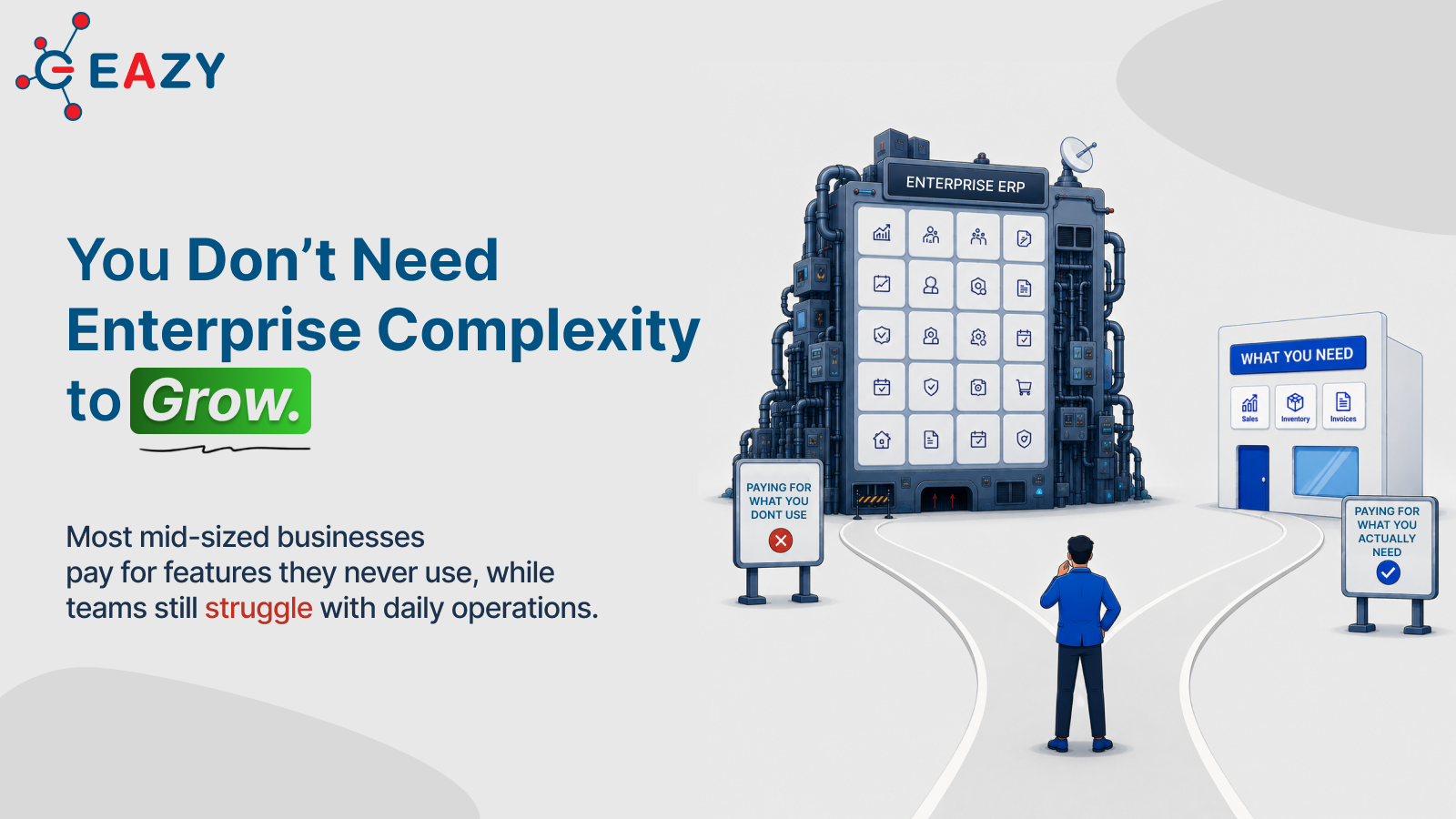
And somewhere during the evaluation process, businesses start feeling: “If we’re investing, why not buy the most powerful system possible?” On paper, it sounds logical but in reality, this is where many mid-sized businesses quietly begin overbuying software they may never fully use. The problem with enterprise ERP systems is not that they are bad, but the problem is that they are often designed for businesses operating at a completely different scale of complexity.
A company managing 5 warehouses, 40 distributors, and a growing sales team does not necessarily need the same operational structure as a global enterprise managing 20 countries, multi-layer compliance, and thousands of users simultaneously. Yet many growing companies end up paying for:
- modules nobody uses
- dashboards teams never open
- workflows employees bypass
- reporting layers leadership never actually needs
And eventually, the ERP starts becoming operationally heavier than the business itself.
The Real Cost of Unused ERP Features
Most ERP discussions focus heavily on implementation cost but very few businesses evaluate: “What happens after go-live?” because unused ERP features do not remain harmless. They slowly create:
- longer onboarding cycles
- lower software adoption
- increased training dependency
- operational confusion
- slower workflows
- dependency on external consultants
Over time, employees stop using the ERP properly because the system starts feeling complicated for everyday execution and this is usually when businesses quietly return to Excel exports, WhatsApp approvals, manual follow-ups, and parallel reporting systems. Ironically, the company ends up paying for enterprise software while operating through manual processes again. This is also one of the biggest reasons ERP adoption fails in mid-sized businesses. Not because teams resist technology but because the software was never operationally aligned with how the company actually functions.
Why Growing Businesses Need Simplicity More Than Complexity
As businesses scale, operational clarity becomes more important than feature count. What growing companies usually need is faster visibility, easier adoption, connected workflows, scalable reporting, distributor visibility, inventory accuracy, field sales tracking, operational flexibility, and not unnecessary complexity. In fact, one of the biggest myths in ERP buying is: “Buying a bigger ERP prepares us for future growth.” That is not always true.
A system built for enterprise-scale operations can sometimes slow down growing businesses because every process starts requiring additional layers, approvals, dependencies, or configurations and eventually the software designed to improve efficiency starts reducing it.
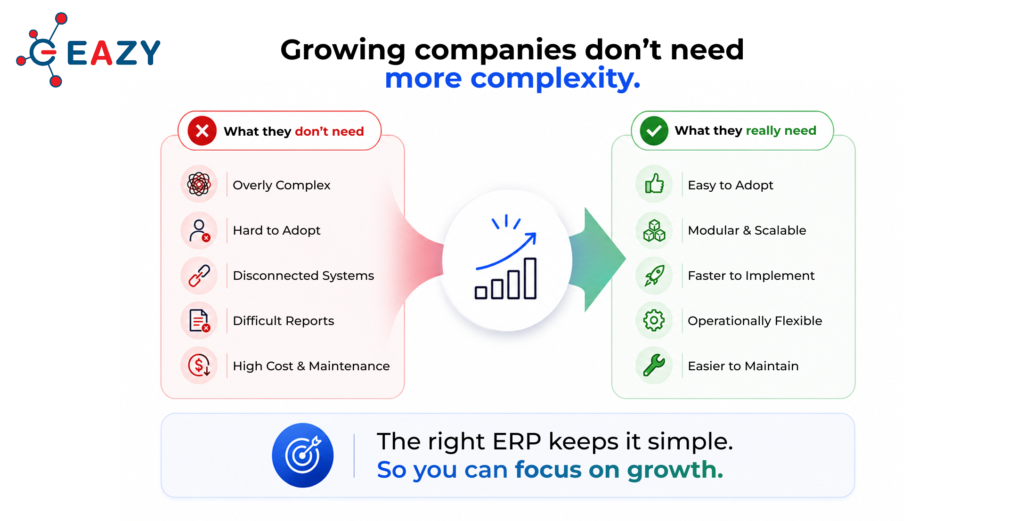
This is why many mid-sized companies today are actively shifting toward ERP systems that are modular, scalable, easier to adopt, operationally flexible, faster to implement, and easier to maintain long-term. According to Gartner, ERP strategies today increasingly need flexibility and composability rather than unnecessary operational heaviness.
What Mid-Sized Businesses Should Actually Evaluate
Before selecting ERP software, growing businesses should stop asking: “How many features does this ERP offer?” And instead ask: “Will our teams actually use this efficiently 3 years from now?” That changes the entire evaluation process because the right ERP for a growing business is not necessarily the biggest one. It is the one that:
- scales without operational friction
- keeps adoption high
- improves visibility
- simplifies decision-making
- supports growth without increasing complexity everywhere
Most businesses do not fail because they lack software, they fail because operations become harder to manage as growth increases, and ERP should reduce that complexity, not multiply it.
If your teams are still depending on Excel despite having ERP software, if employees avoid using certain modules entirely, or if leadership feels the system is becoming heavier with growth instead of simpler, it may be time to rethink what your business actually needs from ERP.
At Eazy ERP, we focus on building connected, scalable ERP ecosystems designed for growing businesses, without unnecessary operational overload.
→ Book a quick demo with us.
We provide a holistic unified ecosystem from ERP, DMS, SFA, to retail platforms, so that your business doesn’t feel broken and you are able to connect the entire supply chain.
FAQs:
1. Do mid-sized businesses need enterprise ERP software?
Not always. Many mid-sized businesses overpay for enterprise ERP features they never fully use. The right ERP depends on operational complexity, scalability needs, and adoption capability.
2. Why do ERP systems fail in growing companies?
ERP systems often fail because businesses choose software based on features instead of operational fit, scalability, and usability.
3. What are the hidden costs of enterprise ERP?
Hidden costs include low adoption, training dependency, external consultant costs, operational delays, maintenance overheads, and unused modules.
4. What ERP features are actually important for growing businesses?
Growing businesses typically need visibility, scalability, connected workflows, inventory tracking, distributor management, reporting accuracy, and ease of use.
5. How do businesses know they have outgrown their ERP?
Common signs include Excel dependency, slow reporting, disconnected workflows, manual reconciliation, and low user adoption.
References:
Articles by Gartner https://www.gartner.com/en/documents/5509895