
Why Cheap ERP Software Often Becomes the Most Expensive Decision
4 min read > 18 May 2026
Key Highlights (What you’ll learn)
- Why cheap ERP software creates long-term operational issues
- Hidden ERP implementation costs businesses often ignore
- How disconnected ERP systems slow decision-making
- Why ERP adoption fails even after successful implementation
- What growing businesses should evaluate before buying ERP software
“By 2027, more than 70% of recently implemented ERP initiatives are expected to fail to fully meet their original business goals.” ~ Gartner
The surprising part is, most ERP failures do not happen during implementation. They happen 2–3 years later, when the business starts scaling and the system that once felt “cost-effective” slowly starts creating operational friction everywhere.
This is what we have experienced while pitching our ERP. We came across a manufacturing company where from the outside, everything appeared running perfectly. Strong distributor network, growing demand, expanding operations, healthy numbers, and honestly, they believed the same internally too. A few years ago, they had selected a low-cost ERP software because it felt financially practical at that stage. The pitch sounded convincing:
“Why invest heavily right now when another ERP vendor is offering similar
functionality at a fraction of the cost?”
That was actually a fair question. Initially, the ERP seemed to work fine, but later back at the start of this year, they came back to us again for a new deployment.
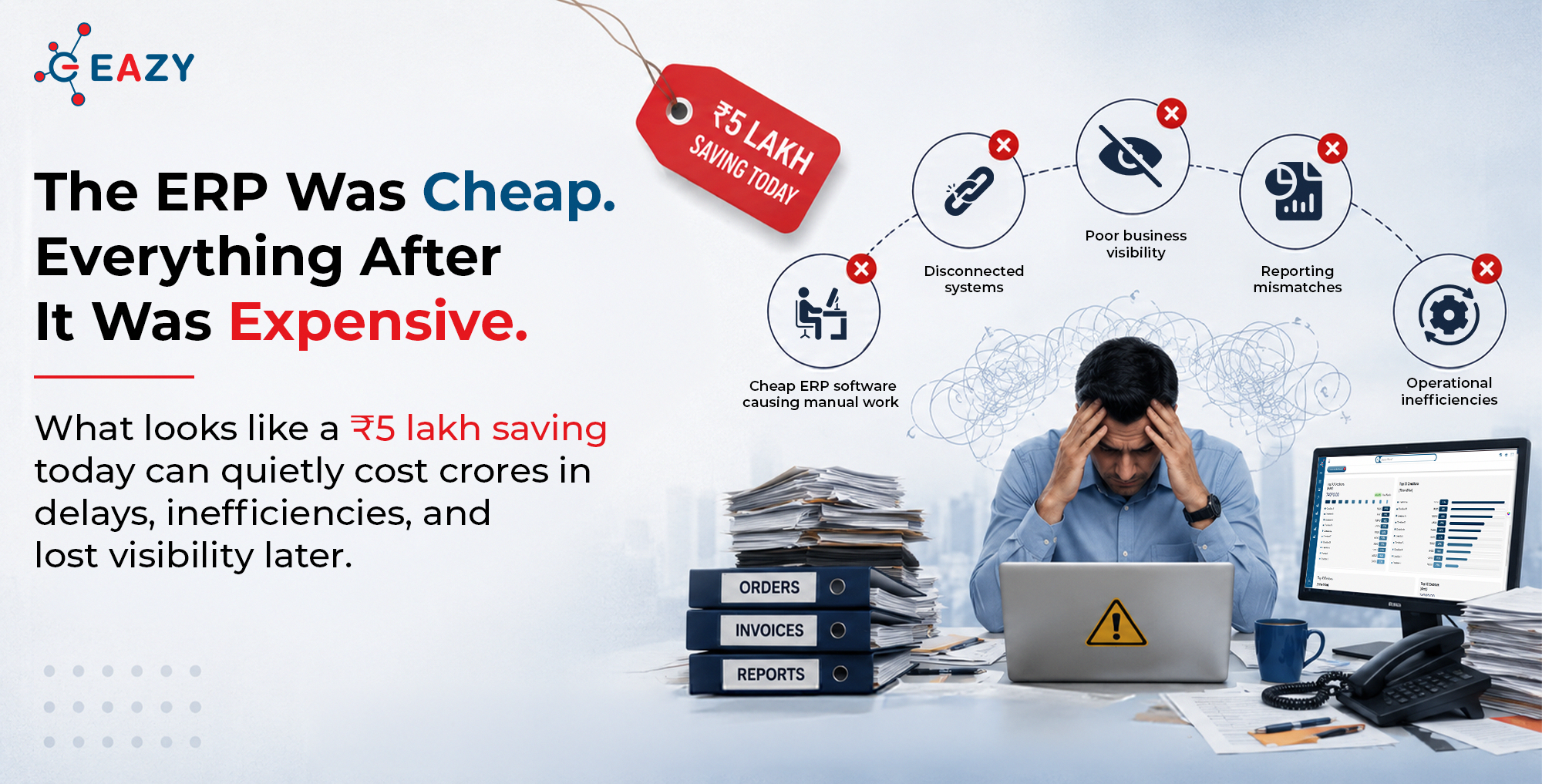
This is perhaps the most dangerous part? Nothing looks “broken enough” initially to trigger the alarm immediately. This is exactly why cheap ERP software becomes risky. The cost rarely appears upfront, but it starts showing slowly through delays, manual work, operational confusion, and decisions taken with incomplete visibility. And by the time businesses realise it, the savings are already gone. Let us explore where exactly are these costs hidden:
What Are The Hidden Costs?
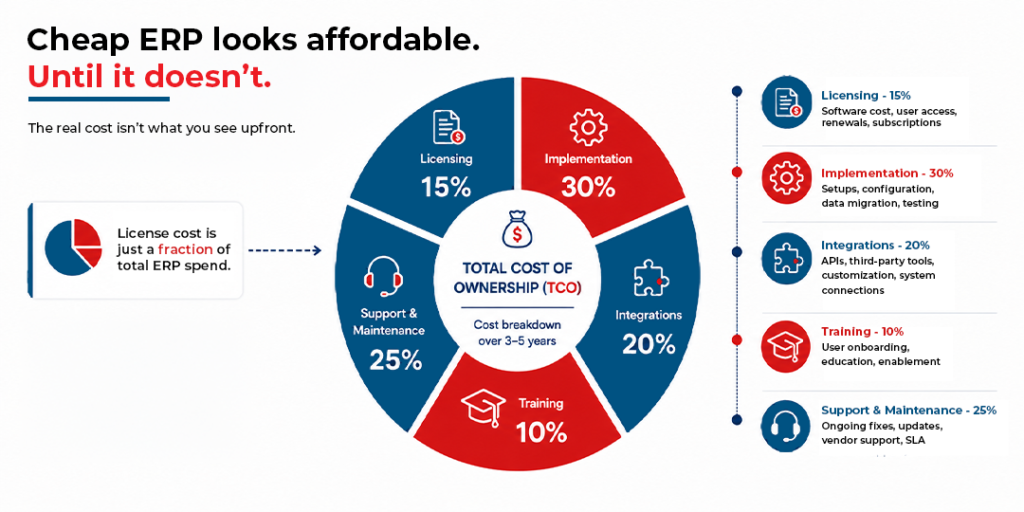
- Cheap ERP Software Rarely Stays Cheap For Long: Most businesses evaluate ERP implementation cost only from a licensing perspective but the actual expense usually comes later through: Custom integrations, third-party tools, maintenance dependencies, additional reporting layers, middleware costs, and manual reconciliation efforts. The software looks affordable but keeping operations functional is not.
- Your ERP Stops Scaling Before Your Business Does: Majority of low-cost ERP software work reasonably well in the beginning but the real problem starts when your business grows. With more distributors, more SKUs, multiple warehouses, extended field sales teams, comes the need of retail visibility, approval layers, and secondary sales tracking. Suddenly, the ERP that once felt “simple” starts becoming restrictive and instead of supporting growth, teams start finding workarounds around the software itself.
- Employees Quietly Go Back to Obsolete Methods: One of the biggest signs of ERP implementation failure is not technical downtime, it is employees exporting data into Excel because they trust spreadsheets more than the system. This happens more often than businesses realise because when ERP visibility feels incomplete, people naturally create manual safety nets for themselves, and once manual work enters the process again, operational inefficiencies multiply silently.
- Data Mismatch Becomes Normal: Disconnected systems create disconnected decisions when the sales team sees one number, finance sees another, inventory tells a different story altogether, and leadership eventually spends more time reconciling reports than acting on them. This is also one of the most common reasons businesses search for: Why does ERP data mismatch happen? Why do reports differ across systems? or How to improve ERP visibility? because fragmented software environments rarely create one version of truth.
- AI Cannot Fix Poor ERP Foundations: Right now, businesses are aggressively adopting AI tools expecting better forecasting, visibility, and decision-making but AI is only as good as the business data underneath it. If your ERP systems are fragmented, disconnected, or inconsistent, AI simply processes inaccurate data faster. That’s why businesses end up searching: Can AI fix disconnected systems? Why do AI projects fail in businesses? How important is clean ERP data for AI? often realise the same thing later: AI cannot repair operational chaos, it only amplifies it.
What Actually Changed
The turning point for the business did not come from adding another software layer. In fact, they had already done enough of that over the years. What changed was the decision to stop operating through disconnected systems and start building a connected operational ecosystem instead.
Once ERP, DMS, and SFA started working together in a unified flow, the difference became visible almost immediately. Sales teams were no longer calling multiple people for stock confirmations. Finance stopped spending hours validating mismatched reports. Leadership meetings shifted from “Which number is correct?” to “What should we do next?”
More importantly, teams slowly stopped depending on parallel Excel sheets because they finally trusted the system again. Over time, this operational clarity translates into faster decisions, and stronger visibility across the supply chain, which in turn helps to reduce friction between departments. In reality, most businesses do not struggle due to lack of technology, they struggle because their technology evolved in small broken steps.
Before You Choose ERP Software, Read This Carefully
Before selecting ERP software, most businesses compare pricing, modules, dashboards, and implementation timelines. Very few evaluate what happens 2–3 years later, when operations become more complex, teams expand, distributors increase, approvals multiply, and leadership starts depending heavily on system visibility for faster decisions. That is usually where the real ERP evaluation begins.
So before choosing any ERP software, it may be worth asking:
- Will this system still support us after years of business growth?
- Can it handle distributors, secondary sales, retail visibility, and field operations together?
- Will our teams actually use it daily or create workarounds outside the system?
- Can leadership trust reports instantly without validation meetings?
- Are we simplifying operations or simply digitising existing confusion?
Because the cheapest ERP decision on paper often becomes the most expensive operationally later.
If your business still depends on Excel despite having ERP software, if teams across sales, finance, inventory, and distribution continue working with different versions of data, or if decision-making still feels slower than it should, the problem may not be operational effort, it may be the systems underneath it.
→ Book a quick demo with us.
We provide a holistic unified ecosystem from ERP, DMS, SFA, to retail platforms, so that your business doesn’t feel broken and you are able to connect the entire supply chain.
FAQs:
1. Why do ERP implementations fail even after go-live?
Most ERP implementation failures happen because initially businesses focus only on deployment, and keep aside operational alignment. Poor integration, low adoption, disconnected workflows, and incomplete visibility eventually creates long-term inefficiencies after go-live.
2. Is cheap ERP software worth it for growing businesses?
Cheap ERP software veiled as affordable solutions may work initially, but growing businesses often outgrow its capabilities quickly. Scalability, integration, reporting accuracy, and operational flexibility become major challenges later.
3. Why do employees still use Excel after ERP implementation?
Employees usually return to Excel or any obsolete method when ERP systems do not provide reliable, real-time, or complete visibility. Excel becomes a manual backup for operational confidence, when they find the current system tedious or confusing.
4. What are the hidden costs of ERP software?
Hidden ERP costs include manual work, integration expenses, delayed decision-making, reporting mismatches, maintenance overheads, employee inefficiency, and poor scalability.
5. Can AI solve disconnected business systems?
No. AI depends on connected and accurate data. If business systems are fragmented, AI amplifies inconsistencies instead of improving decision-making.
6. What should businesses evaluate before buying ERP software?
Businesses should evaluate scalability, integration capability, reporting accuracy, usability, operational fit, long-term support, and adoption potential, not just pricing.
References:
Enterprise Resource Planning to Optimize Operations by Gartner
https://www.gartner.com/en/information-technology/topics/enterprise-resource-planning