What Is Agentic ERP and Why Should Businesses Care?
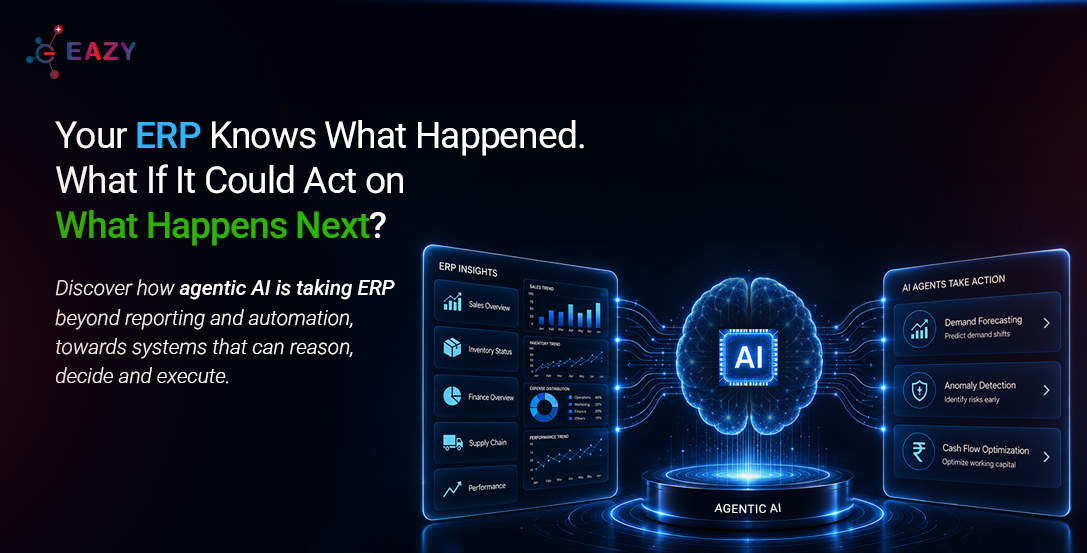
ERP has always told businesses what happened. Agentic ERP is beginning to answer a different question: what should happen next?
5 min read > 25 Aug, 2026
Key Highlights (What you’ll learn)
- What agentic ERP is and how it differs from traditional ERP
- How AI agents can automate and execute everyday ERP processes
- Where agentic AI can impact finance, inventory, sales and procurement
- The business benefits and challenges of adopting agentic ERP
- What businesses should consider before moving towards an AI-ready ERP
That is the interesting shift happening in enterprise software. AI is moving from answering questions to taking action and as that capability enters ERP, the conversation is no longer just about smarter dashboards or faster reports. It is about whether the system can understand what is happening across the business, decide what needs attention and act on it.
This is where agentic ERP enters the picture.
Deloitte’s 2025 Tech Value Survey found that 74% of organisations surveyed had invested in AI or generative AI in the previous year, making it the most widely funded technology capability in the study. At the same time, ERP investment increased from 35% to 43%. Even more telling: 47% of organisations investing in AI also invested in ERP, compared with only 21% of those that did not invest in AI.
The message is becoming difficult to ignore: AI may be the intelligence layer, but the business still needs a system that understands how the business actually runs.
What Is Agentic ERP?
Definition: Agentic ERP is an ERP system enhanced with AI agents that can understand business context, reason through tasks, make decisions and execute actions with limited human intervention.
An agentic ERP could go further: assess stock availability, consider the customer’s credit status, identify a potential fulfilment issue, recommend an alternative, initiate the appropriate workflow and alert the relevant person only if the situation falls outside predefined boundaries.
That is the difference between automation that follows instructions and intelligence that can work towards an outcome. The technology is still evolving, but its defining characteristic is the ability of AI agents to adapt to context and act rather than simply generate information.
Agentic ERP vs Traditional ERP: What Actually Changes?
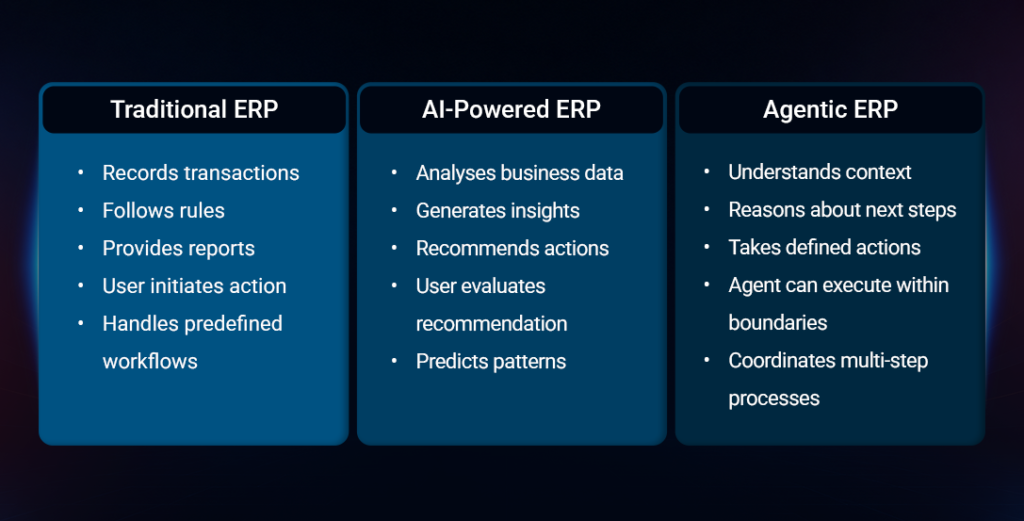
The easiest way to understand agentic ERP is to look at what happens between information and action. From a layman perspective, a traditional ERP primarily works on a record-and-respond model, that records transactions, applies rules, generates reports and helps people respond to what has already happened. AI-enabled ERP goes a step further, where it can analyse that information, identify patterns and provide recommendations.
Agentic ERP takes the next step. It can observe → reason → decide → act → learn from the outcome, within business-defined rules and permissions.
For example, imagine a distributor whose inventory for a fast-moving SKU is falling faster than usual. A conventional ERP can tell the sales manager the current stock position, an AI-enabled ERP might flag the unusual movement and predict a potential shortage but an agentic ERP could go further:
- identify the abnormal demand pattern,
- check open orders and current inventory,
- consider lead times and reorder rules,
- recommend or initiate replenishment,
- alert the relevant person if approval is required,
- and update the workflow once the decision is made.
The difference is subtle in description but significant in operation and eventually, the system moves from telling people what is happening to helping move the business forward.
But this totally does not mean humans disappear from the process. Quite the opposite. The goal is to move people away from repetitive coordination and towards decisions that actually require human judgment.
That distinction matters because ERP environments are complex. Finance, inventory, sales, procurement and operations are interconnected, and decisions in one area can affect another. Agentic AI is being explored precisely because it can work across these connected processes rather than treating every task as an isolated automation.
Why Agentic ERP Is Becoming Relevant Now
McKinsey’s 2025 State of AI survey found that 88% of respondents said their organisations regularly use AI in at least one business function. Yet only about one-third said their organisations had started scaling AI across the enterprise.
That gap tells us something important. Businesses don’t necessarily have an AI availability problem, they have an integration problem.
An AI model can identify a sales anomaly but if the sales data sits in one application, inventory in another, finance somewhere else and approvals happen over email, someone still has to connect the dots. That is the integration problem. That is where Agentic ERP becomes interesting.
Instead of adding AI as another tool around the business, it puts intelligence closer to the business processes themselves. From automation to autonomy, there is an important distinction here.
Automation follows predefined instructions: If X happens → do Y.
Agentic systems are designed to work with more context.
Something has changed → understand why → determine the appropriate response → take the permitted action.
What Can AI Agents Do in ERP?
The possibilities become clearer when we stop talking about “AI” as a single feature and start thinking about specialised AI agents working on specific business objectives.
- Finance and Accounts
Finance teams spend considerable time identifying exceptions, following up on receivables, checking transactions and preparing information for decisions. An agent can monitor defined financial conditions, identify anomalies, prioritise follow-ups and escalate exceptions according to business rules.
So, instead of waiting for someone to find a problem in a report, the system can bring the problem forward. That can shift finance from constantly chasing information toward managing exceptions and decisions.
- Inventory and Procurement
An AI agent could monitor stock levels, sales patterns and procurement conditions to identify potential shortages or excess inventory. It could recommend what needs to be replenished, when and why, while escalating decisions that fall outside business rules.
Because inventory decisions are rarely about one number. They depend on demand, stock levels, open orders, lead times, seasonality and purchasing policies. An agent can bring those variables together continuously rather than waiting for someone to manually analyse them.
The goal isn’t simply better forecasting but it is faster action when the forecast changes.
- Sales & Demand
Imagine an ERP that doesn’t simply show declining sales but notices that a region, product or customer segment is deviating from its usual pattern. The system could flag the issue, analyse related information and initiate the next step in the sales workflow.
So basically, instead of simply showing declining sales, an agent can monitor sales trends, identify unusual drops, compare them with historical patterns and flag accounts or products requiring attention.
It can move the conversation from: “What happened to sales?” to: “Here’s what changed, why it may have changed, and what needs attention.”
- Order & Customer Management
AI agents can potentially interpret information from different sources, validate orders against business rules and coordinate multiple steps instead of relying on employees to manually move information between systems.
Also, an agent can connect customer history, outstanding orders, complaints, payments and previous interactions to determine the context behind a request. Instead of treating every ticket as a new event, the system can understand the customer relationship behind it.
- Exception Management
This may be one of the most valuable applications as business processes rarely go exactly as planned. A rule-based workflow can handle the expected scenario. The moment something unusual happens, a person often has to step in. Agentic AI is designed to handle more context and adapt to exceptions, while keeping humans involved where decisions require approval or accountability.
Your ERP already has the data but what if it could do more with it?
Explore how an AI-powered ERP can help connect business processes, automate routine work and give your team more time to focus on decisions that matter.
Benefits of Agentic ERP for Businesses
The biggest advantage isn’t simply “more automation,” it is less distance between knowing and doing.
- Less Manual Coordination: Employees spend considerable time moving information between systems, checking statuses, following up and initiating routine actions. AI agents can take over parts of this coordination.
- Faster Decisions: When relevant information is already available inside the ERP, agents can analyse it and trigger the appropriate next step without waiting for multiple handoffs.
- More Proactive Operations: Traditional ERP is often retrospective: What happened? What is the current position? Agentic ERP moves towards a more proactive question: What needs attention next?
- Better Exception Handling: Instead of treating every exception as a manual problem, AI agents can analyse context, identify likely causes and route the issue appropriately.
- Employees Focus on Higher-Value Work: The objective isn’t to automate people out of business. It is to automate the coordination that keeps people busy but rarely creates strategic value.
Agentic AI in ERP: What Are the Challenges?
Agentic ERP sounds powerful but businesses shouldn’t treat it as a licence to let AI make unlimited decisions.
ERP systems sit at the centre of critical business processes. A wrong decision in finance, inventory or procurement can have real consequences. That makes control, data quality, security, permissions and human oversight essential. Businesses also need clearly defined boundaries: What can an AI agent do independently? What requires approval? What happens when the system is uncertain?
There is another practical challenge.
Agentic AI works best when the underlying business data and processes are connected and reliable. If information remains scattered across disconnected systems, adding an AI agent does not automatically solve the underlying problem.
In other words, agentic ERP isn’t about putting a chatbot on top of an ERP. It is about giving intelligence access to the right business context and the ability to act within controlled workflows.
Deloitte’s research highlights this indirectly. While AI and gen AI attracted investment from 74% of respondents, data management and architecture stood at 55%, cloud platforms at 47%, and ERP at 43%. Deloitte also found that AI automation was consuming an average of 36% of digital initiative budgets among respondents allocating money to it.
At the same time, Deloitte found that 60% of organisations cited data privacy and security as a major hurdle to AI automation.
This is why Agentic ERP shouldn’t be viewed as simply “ERP + AI”. It is about bringing together: Data + Processes + AI + Rules + Permissions + Human Oversight.
Is Agentic ERP the Future of Business Software?
Possibly, but the bigger shift is already underway. ERP has evolved from systems that primarily record transactions to platforms that connect processes, automate workflows and provide real-time visibility. Agentic AI represents another step in that progression: systems that can increasingly interpret context and participate in execution.
Is Agentic ERP ready for every business? Not necessarily and this is where the hype around AI needs some perspective.
McKinsey’s research shows that while AI adoption is widespread, most organisations are still struggling to move from experimentation to enterprise-scale impact.
The same lesson appears in Deloitte’s research: AI is generating real returns, but value is uneven, and organisations need stronger foundations, aligned strategies and better measurement to capture it. So the question shouldn’t be: “Does our ERP have AI?”
A better set of questions is:
- Can our systems understand the same business context?
- Is our data reliable enough to support automated decisions?
- Which decisions can safely be delegated?
- Where should human approval remain mandatory?
- Can we measure whether AI-driven actions actually improve business outcomes?
Those questions separate useful Agentic ERP from AI theatre.
What should businesses look for in an Agentic ERP?
→ Connected data so agents can see the complete business context.
→ Process awareness so AI understands workflows rather than isolated transactions.
→ Reasoning capabilities so it can evaluate multiple variables before recommending an action.
→ Controlled autonomy so actions happen within permissions, thresholds and approval rules.
→ Human oversight so important decisions remain accountable.
→ Measurable outcomes so businesses can track whether the system is actually improving revenue, costs, productivity, working capital or customer experience.
That last point is critical. The success of Agentic ERP should not be measured by how many AI features it has. It should be measured by what the business can do better because of them.
Final Takeaway
Agentic AI isn’t replacing ERP. It’s changing what businesses can expect from it.
The next generation of ERP won’t simply give businesses more data, dashboards or automation. It will increasingly help them interpret that data, identify what needs attention and take action within defined business rules.
At EAZY, we’ve spent over 18 years helping 650+ businesses build connected ERP, DMS, SFA, CRM and HRMS ecosystems. That experience has reinforced one thing: AI can only be as useful as the business data, processes and systems it can work with.
Not sure whether your current ERP, DMS, or SFA setup is AI-ready? We’ll spend 30 minutes reviewing your existing technology stack and tell you honestly what needs to change and what doesn’t. → ERP Implementation Checklist
See how EAZY ERP combines connected business processes, automation and AI-powered capabilities to help businesses move from simply managing operations to running them smarter.
Frequently Asked Questions
- What is agentic ERP?
Agentic ERP is an ERP system enhanced with AI agents that can understand business context, make decisions within defined boundaries and execute actions with limited human intervention. - How does agentic AI work in ERP?
Agentic AI uses business data, AI models, rules, workflows and contextual information to assess situations, determine appropriate actions and execute tasks. Human intervention can remain part of the process for approvals, exceptions and high-impact decisions. - What can AI agents do in ERP?
AI agents can potentially support finance, inventory, procurement, sales, order management, reporting, exception handling and other multi-step business processes. - What is the difference between AI and agentic AI in ERP?
Traditional AI may analyse data, generate insights or provide recommendations. Agentic AI goes a step further by using those insights to plan and execute actions towards a defined objective. - Is agentic ERP the future of enterprise software?
Agentic ERP is emerging as an important direction for enterprise software. Its potential lies in combining ERP’s business data and workflows with AI agents capable of reasoning and taking action.
References:
Continue Reading: